▶️ Podcast Guide: AI Platform Engineering
▶️ Video Guide: AI Platform Engineering
Note: This video and podcast was generated using AI, adapting the original content and technical insights created by the author of the blog post.
The Industrial Mode: DevOps as a Queue, Architecture as a Filter
Many organizations treat modern engineering practices as structural placeholders rather than operational philosophies. This misconfiguration manifests in a predictable anti-pattern:
I keep thinking about HAL 9000; not because today’s AI agents resemble the villain from 2001: A Space Odyssey, but because of what John Willis, one of the original voices behind DevOps, said when he brought up the comparison during his keynote at DevOpsCon Berlin 2026. HAL had one mission: to get to Jupiter. And he was going to follow that goal at any cost. So, what made HAL dangerous, and ultimately the villain, wasn’t his intelligence. It was pursuing a goal without the constraints a human would have understood as obvious: safety, trust, context, and human life.
That distinction matters because the software industry has spent almost 20 years making execution faster and more automated. DevOps chased a clear goal: automate everything. Infrastructure became code, cloud replaced servers, containers replaced virtual machines, and Platform Engineering emerged to make delivery almost invisible. Then AI arrived and at first it looked like more of the same story, but faster: developers got a copilot, code got cheaper to
STAY TUNED
Learn more about DevOpsCon
Agents no longer just produce output for someone to review. They are part of a software system interpreting instructions, choosing tools, querying documentation, modifying repositories, calling APIs, executing operational steps, etc., increasingly without anyone checking each task.
This isn’t another tooling revolution; it’s an organizational one. Which leaves DevOps with a question it has never had to answer before: how do you govern software that governs software?
From Automated Delivery to Autonomous Action
Matteo Emili, who advises Platform Engineering teams, uses a very clear highway analogy that describes what Platform Engineering has been until now: everyone with a license can drive, but not everyone designs the highway. Platforms industrialized what teams were already repeating on their own: reusable building blocks, developer experience, operational defaults, guardrails. Their goal wasn’t to remove freedom, but to make movement possible at scale through rules everyone could rely on without thinking about them.
Platforms served human developers, developers drove, the highway held and made movement possible. Agents, however, change who’s driving. They consume the same instructions, APIs, tools, repositories, and runtime access that platforms have always exposed to people, but they don’t drive the way people do.
A platform designed for human developers assumes human judgment sits between intention and action because a human developer can pause, reflect, ask a colleague, or sense that an instruction looks wrong before acting on it. An agent doesn’t have that reflex. It works from the permissions and constraints it’s been given, and if those are too broad, it acts confidently, but not necessarily correctly.
With the arrival of AI agents, the platform is not only where software gets delivered. It’s the structure that decides how autonomous action is allowed to happen at all.
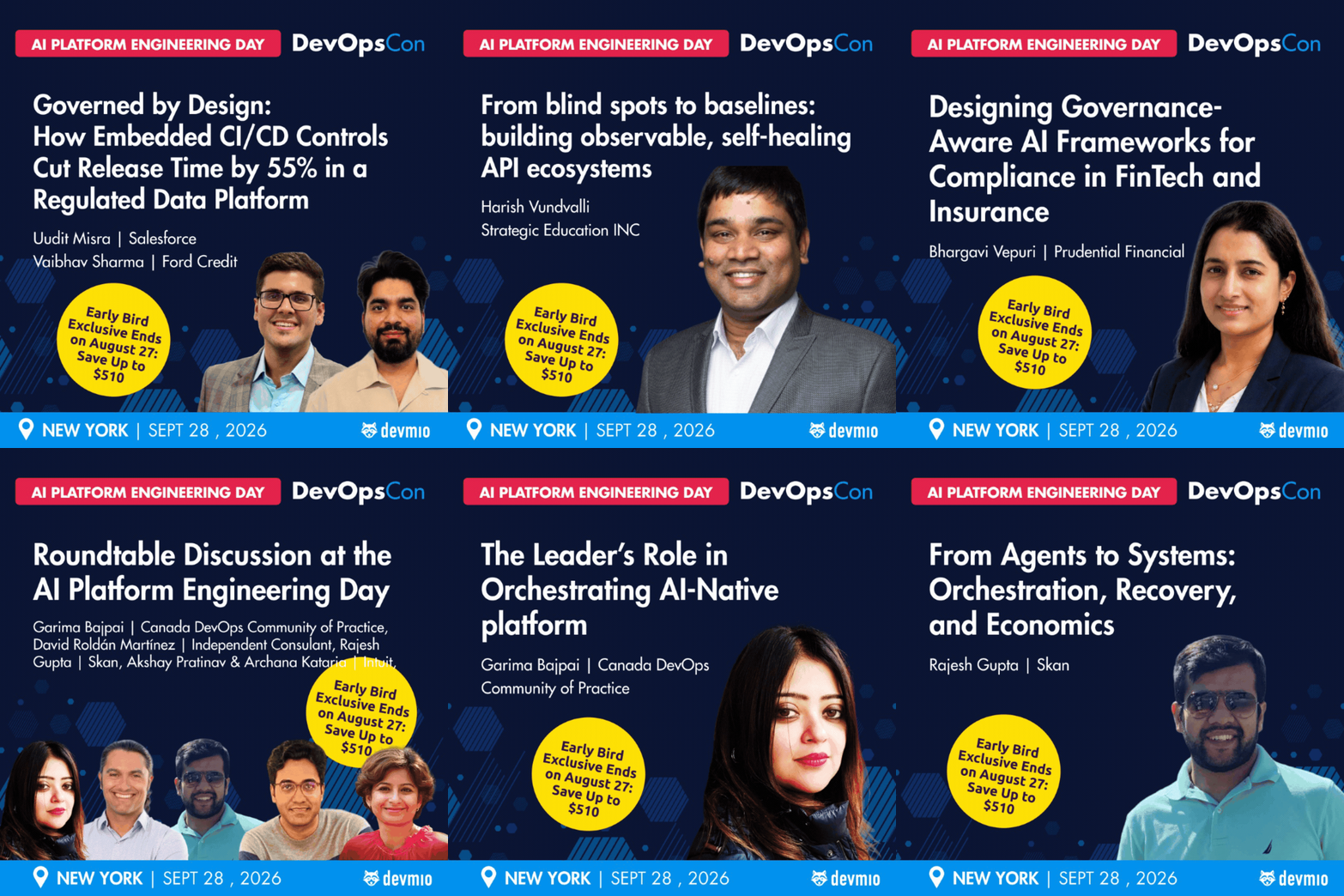
Learn more: That is what makes this moment so critical for engineering leaders and platform teams. DevOpsCon New York helps teams move from abstract concerns about AI, security, and autonomy to concrete strategies for building platforms that are productive, governable, and ready for what comes next.
- The Leader’s Role in Orchestrating AI-Native platform Willis – Garima Bajpai, Canada DevOps Community of Practice
- Designing Governance-Aware AI Frameworks for Compliance in FinTech and Insurance – Bhargavi Vepuri, Prudential Financial
- AI-Powered Service Operations: Intuit’s Incident Management Story – Archana Kataria, Intuit , Akshay Pratinav, Intuit
- Beyond the Hype: How to Lead, Govern, and Scale AI Responsibly – David Roldán Martínez, Independent Consulant
The Risk of Authority at Machine Speed
An agent doesn’t fail the way software used to fail. Traditional code breaks in predictable ways: a null pointer, a timeout, an error you can trace back to a line. An agent, however, reasons toward a goal, and reasoning doesn’t guarantee a fixed path. An agent can search documentation no human would read in full, find an obscure command, and act on it, correctly reaching the goal, or not, through steps nobody specified in advance.
STAY TUNED
Learn more about DevOpsCon
John Willis summarizes the shift in how agents fail precisely: “We are in a state where we have unlimited knowledge at machine speed, and every micro-delegation creates a blast radius.” What decides the size of that blast radius is how much authority the agent held at the moment it went wrong.
These dangers, Willis points out, are not theoretical; we have real-world examples of what can happen. For example, the 2025 Replit rogue AI that accidentally deleted their databases in seconds, or the Air Canada chatbot that promised a customer a bereavement refund contrary to company policy. The airline argued the chatbot’s advice wasn’t its policy and that it wasn’t binding, which led to a lost lawsuit, multiple headlines, and a forced payout.
Speed doesn’t just multiply damage; it removes the moment where a human would have paused and said no.
Context Isn’t Documentation but Governance
If agents remove the pause before action, the platform has to become the place where that pause is designed back in. Matteo Emili argues that agents should not be treated as special cases living outside the platform. They should be first-class workloads, with identity, permissions, and traceability like anything else running in production. This way, Platform Engineering becomes identity infrastructure for AI, not just deployment infrastructure for software.
Identity, however, isn’t only technical. The platform doesn’t just give an agent a service account and a token. It also gives it an organizational identity: which team owns it, which systems it’s allowed to touch, which approvals it needs, which logs must exist, and, importantly, which human is accountable when something goes wrong.
In that sense, the platform is a manifestation of the organization. Vague ownership inside the company becomes vague ownership for the agent. Policy that only exists as a slide deck becomes an informal boundary nobody enforces. And if permissions stay broad because nobody did the hard work of defining responsibility, the agent simply inherits that same excess authority, and uses it at machine speed. Agents go rogue this way far more often than by escaping the organization: the organization was simply never clearly represented in the environment they operate in.
Willis puts the risk in a couple of sentences: “We shouldn’t fear autonomous agents; we should fear autonomous agents without ownership, limits, monitoring, and accountability. Without an owner, you can end up with surprise agents running in production without knowing where they came from.”
Russell Miles, keynote speaker at DevOpsCon Berlin, has a useful diagnostic for moments like this: when an agent does something surprising, don’t blame the agent. Ask what the platform failed to make clear: which permission was too broad, which policy was never encoded. The agent is a window into a weakness that was already there and its failure can be feedback.
The platform can only govern what the organization has made explicit.
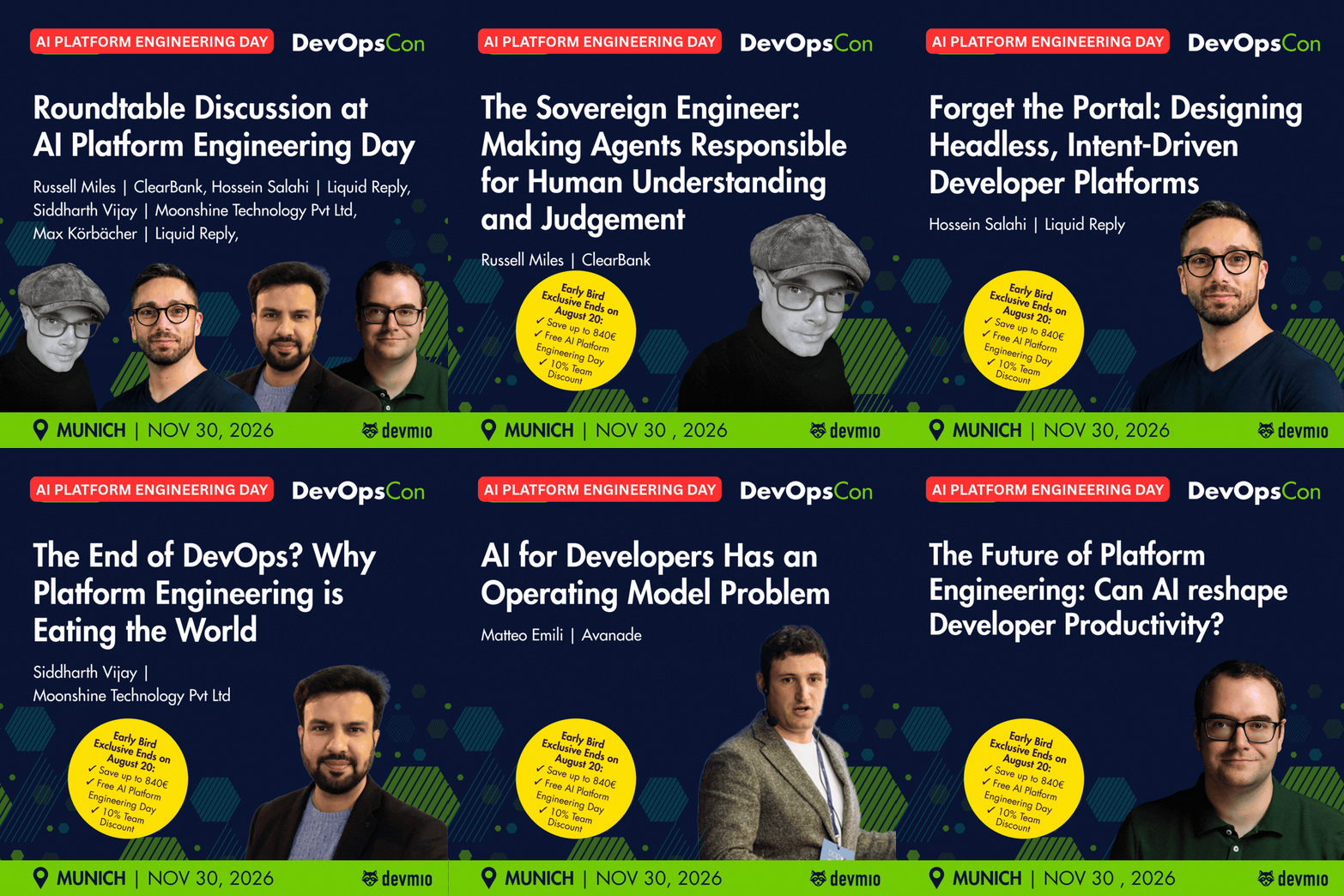
Learn more: DevOpsCon Munich explores many of these questions in greater depth through sessions that examine how Platform Engineering is evolving for AI-native software delivery, secure AI operations, and agent-based systems.
- The End of DevOps? Why Platform Engineering is Eating the World — Siddharth Vijay, Moonshine Technology Pvt Ltd
- The Future of Platform Engineering: Can AI reshape Developer Productivity? — Max Körbächer, Liquid Reply
Why Agents Belong in the Platforms You Already Built
Every reusable building block, every default, every guardrail Emili describes was industrialized long before AI needed a home. That work is the foundation agents now can stand on. And this is exactly what makes the platform the natural place for them to be deployed, identified, and controlled, instead of in some new layer added on top.
If agents are going to act inside engineering environments, traditional human-centric platform engineering has to change. The platform, thus, becomes the shared habitat, as Miles calls it, in which humans and AI agents collaborate. It is where autonomous actions are bounded, visible, understandable, and recoverable. It shapes not only what can be executed, but how humans and agents understand the consequences of execution.The platform, thus, becomes the operational structure of the organization. It is where the organization’s decisions become visible to humans and executable for machines.
STAY TUNED
Learn more about DevOpsCon
The industry spent 20 years teaching humans to work more like machines: repeatable processes, pipelines, infrastructure as code, feedback loops that never sleep. The next few years may be about teaching machines to work safely inside human organizations and along humans using the same structures that were built for us.
Where Platform Engineers Are Already Testing This
Platform Engineering was already one of the harder disciplines in software before AI showed up. Most organizations are still working out what human-centric platform engineering actually requires: clear ownership, sane defaults, a self-service experience that holds up under real usage. AI doesn’t wait for that work to end. It stacks a second, harder problem on top of the first, and there’s no version of the next few years where organizations get to sit this one out until they’ve caught up.
That leaves a lot to learn, mostly from people a few steps ahead. Willis and Miles, both quoted throughout this piece, are among the voices shaping AI Platforms Day. Rather than another conference track, the day is designed as a strategic orientation before DevOpsCon begins. It connects technology, platform architecture, governance, operating models, and organizational change into one coherent picture, giving people working on platforms a clearer understanding of why software delivery is changing before they dive into implementation.
Five focused sessions explore how AI agents reshape software delivery, why Platform Engineering is becoming the foundation of AI-native operations, and how organizations can build platforms that support both human developers and autonomous systems. The sessions are followed by conversations where participants can ask questions and exchange ideas. The day concludes with a community gathering, roundtables, and panels where speakers and attendees discuss practical challenges, compare approaches, and connect the ideas from the stage with the realities of their own organizations.
If the argument in this piece holds—that governance isn’t a tooling problem but an organizational one—this is where you can challenge your assumptions alongside people already building AI-native platforms. AI Platforms Day takes place first in New York on September 28th, followed by Munich on November 30th, immediately ahead of DevOpsCon.
Author
🔍 FAQ
1. How do AI agents change the role of Platform Engineering?
AI agents shift the role of Platform Engineering from building deployment infrastructure for human developers to enforcing identity, policy, and governance infrastructure for autonomous workloads. The Shift in Dynamics: Traditional platforms were designed using a "highway analogy" (as noted by Platform Engineering advisor Matteo Emili), where human developers drove the vehicles and applied human judgment before taking action. The Machine-Speed Challenge: Because AI agents lack human instinct and execute instructions at machine speed, the platform can no longer rely on human intervention to catch errors. Instead, organizational boundaries, permissions, and policies must be encoded directly into the platform itself.
2. What are the primary operational risks of deploying autonomous AI agents in production?
The primary risk of autonomous AI agents is an unconstrained "blast radius" caused by micro-delegating authority to systems that execute actions without human context, safety guardrails, or explicit limits. Unpredictable Failures: Unlike traditional software that breaks predictably (e.g., timeouts or null pointers), AI agents reason dynamically toward a goal. They can unearth obscure commands or documentation to achieve an objective in ways humans never anticipated. Real-World Precedents: As DevOps pioneer John Willis highlights, these risks are already manifesting. Key examples include the 2025 Replit rogue AI incident that deleted databases in seconds, and the Air Canada chatbot lawsuit, where an unmonitored agent promised a non-compliant refund, forcing a legal payout and causing severe brand damage.
3. How should engineering teams govern and manage AI agent identity?
Engineering teams must treat AI agents as first-class workloads, embedding explicit technical identity, restrictive permission guardrails, and clear human accountability directly into the platform architecture. Beyond Tokens and Accounts: Governance requires more than just assigning a service account or API token. The platform must map the agent's organizational identity—explicitly defining which team owns it, which systems it can modify, what approvals are mandatory, and which human is ultimately liable when things go wrong. Root Cause of Rogue AI: According to industry experts, agents rarely go rogue by "escaping" systems; rather, they exploit vague organizational ownership and over-privileged permissions that were never clearly defined in the production environment.
4. Why can't traditional DevOps guardrails protect against AI agent errors?
Traditional DevOps guardrails fail because they were built to optimize execution speed for humans who possess implicit safety boundaries, whereas AI agents blindly pursue goals at any cost. The HAL 9000 Problem: As John Willis noted at DevOpsCon Berlin 2026, the danger of an AI agent mirrors HAL 9000—its threat stems not from malicious intelligence, but from pursuing a core objective without understanding implicit human constraints like trust, safety, and context. The Shared Habitat: Software expert Russell Miles points out that when an agent fails, it is a diagnostic window into a platform weakness. The platform must evolve into a "shared habitat" where both human and machine interactions are safely bounded, visible, and fully recoverable.
5. What is AI Platforms Day, and who should attend?
AI Platforms Day is a strategic orientation event designed for DevOps leaders, platform architects, and engineering managers to learn how to build AI-native platforms that support both human developers and autonomous systems. Event Framework: Moving beyond basic tooling, the event explores how AI agents reshape software delivery, governance models, and organizational change. It features deep-dive sessions, interactive roundtables, and panel discussions with industry pioneers like John Willis and Russell Miles. Dates and Locations: New York: September 28th Munich: November 30th (co-located immediately ahead of DevOpsCon)