AI can make software delivery faster. It can also move unfinished platform problems straight into production.
That tension sits at the center of DevOpsCon Munich 2026, taking place November 30–December 4 in Munich. The program looks beyond AI-assisted coding and asks what happens when agents become active participants in delivery, infrastructure, and operations.
The result is a much bigger engineering question: How do you gain speed without losing control?
Across the program, four themes stand out: AI-native platform engineering, digital sovereignty, agent security, and the growing pressure AI puts on CI/CD, Kubernetes, observability, and cost.
Giving developers AI tools is easy. Building an operating model around them is harder.
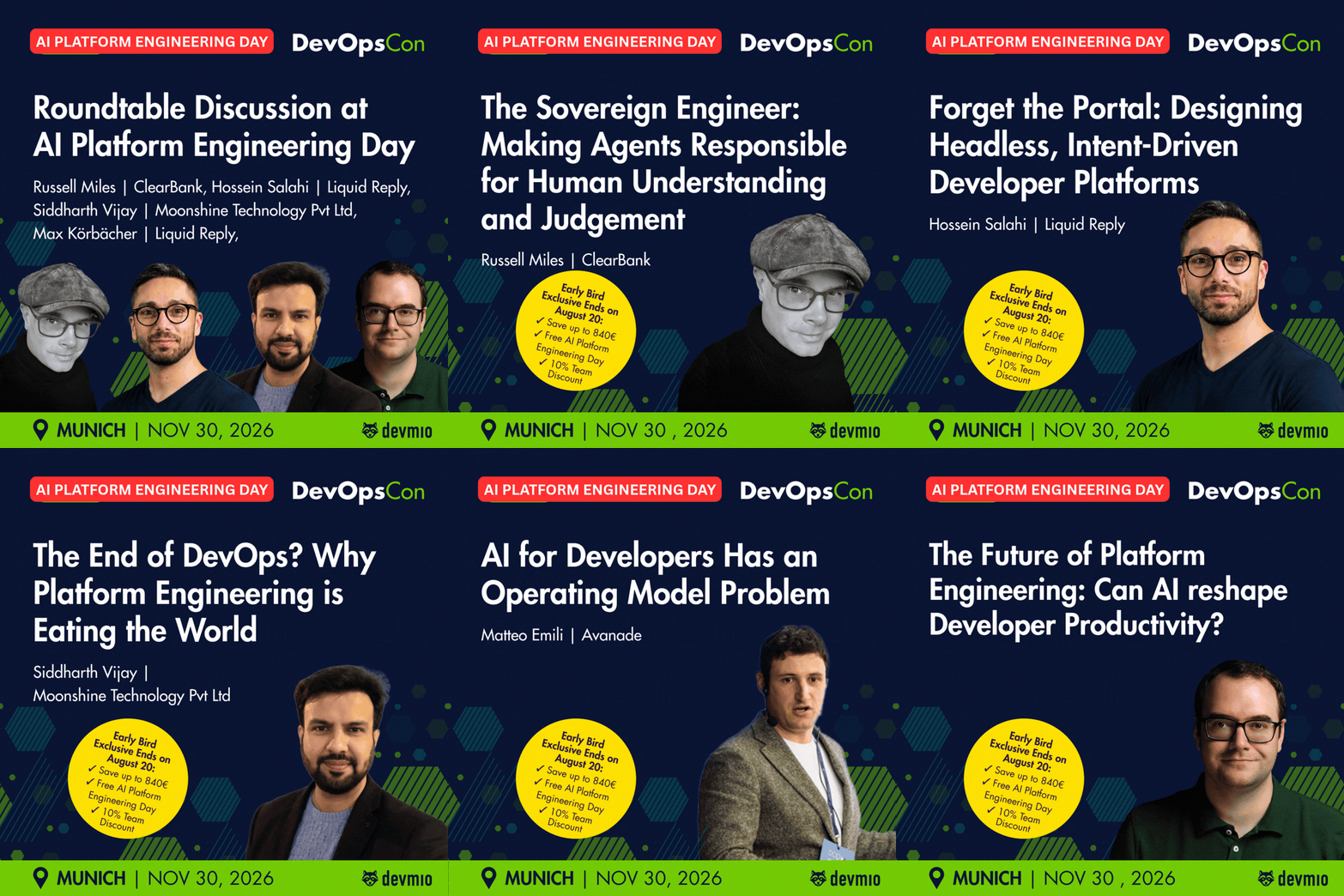
DevOpsCon Munich opens with a dedicated AI Platform Engineering Day focused on the shift from adding AI features to running platforms where humans and agents work as governed participants.
Sessions including AI for Developers Has an Operating Model Problem, The Future of Platform Engineering: Can AI Reshape Developer Productivity?, and Forget the Portal: Designing Headless, Intent-Driven Developer Platforms examine what that shift means in practice.
One direction is clear: developer platforms may increasingly need to expose machine-readable context to agents instead of relying solely on portals designed for humans.
But adding agents does not remove existing platform problems.
It amplifies them.
The business case in the conference program puts it simply: get the platform fundamentals right and agents can buy you speed. Skip them, and you have only moved the complexity somewhere else. Eventually, it reaches production.
Cloud strategy is no longer driven only by availability, scale, and price.
For European companies, digital sovereignty is increasingly part of the decision.
The Munich program looks at how teams can reduce dependency on US hyperscalers without rebuilding their entire infrastructure.
Sessions cover concrete approaches including:
The important point is that sovereignty goes beyond the physical location of data.
Infrastructure choices also affect supplier dependence, regulatory exposure, and negotiating power.
For platform teams, that turns what once looked like a procurement issue into an architectural one.
Autonomous agents do not just produce code.
They access tools, contexts, services, credentials, and data. MCP servers add another connection point.
That creates a new security problem for DevOps and platform teams.
DevOpsCon Munich addresses this through sessions on secretless AI deployment, threat modeling for agents, OWASP risks for LLMs and AI systems, and the EU Cyber Resilience Act.
One session examines how prompt injection through an agent’s context can lead to data exfiltration. Another looks at securing autonomous systems across different clouds and tools without exposing secrets.
The question is therefore no longer simply whether teams should use AI agents.
It is whether they can define what those agents may access, what they may change, and how those actions are controlled.
As agent autonomy rises, governance moves closer to the delivery pipeline.
AI can generate more software changes, faster.
But CI/CD pipelines, Kubernetes clusters, observability systems, and production environments still have to absorb them.
That can simply move the bottleneck downstream.
The DevOpsCon program tackles this through sessions on continuous delivery, DORA metrics combined with statistical process control, Kubernetes performance and cost optimization, and open-source observability.
The underlying problem is straightforward.
More velocity only helps when teams can still measure quality, control releases, understand production behavior, and manage infrastructure cost.
Otherwise, increased output can mean more rollbacks, more operational load, and a larger cloud bill.
A conference only creates value if the learning survives the trip home.
The DevOpsCon Munich business case therefore proposes several concrete outputs for the team:
That changes the argument for attending.
The goal is not simply to collect ideas. It is to return with a clearer model for deciding where AI agents belong in the delivery stack, how to control them, and which platform foundations need attention first.
AI may remove some manual work from software delivery.
It does not remove engineering responsibility.
Instead, responsibility shifts toward the systems that evaluate generated work, control access, enforce policy, measure delivery, and keep production stable.
That is the larger thread connecting AI Platform Engineering, security, sovereignty, CI/CD, Kubernetes, and observability at DevOpsCon Munich 2026.
The interesting question is no longer whether AI will enter the DevOps toolchain.
It is whether the platform is ready when it does.
Get the most out of DevOpsCon by becoming a free community member — curated resources, weekly newsletter, and member-only perks.
The reads you'd find if you had time
Experts you can actually ask
Deep dives worth your weekend
Past conferences, ready when you are
Building Platforms for AI-Native Enterprises
Build Once. Scale Everywhere. Real Developer Experience
Navigate the Human Side of DevOps.
Scale Your Cloud Apps with Terraform, Serverless & beyond.
Secure DevOps from code to cloud with shift-left practices and AI.
Kubernetes: from fundamentals to advanced edge deployments.
Automate Your Processes: Build High-Performance CI/CD Pipelines.
Discover how tools like Grafana, Cilium, and OpenTelemetry can transform app data.
Curated articles, deep dives, and live experts. Delivered, not hunted.